Ringus successfully deployed OutSystems for TXC Corp. with CRM application delivery
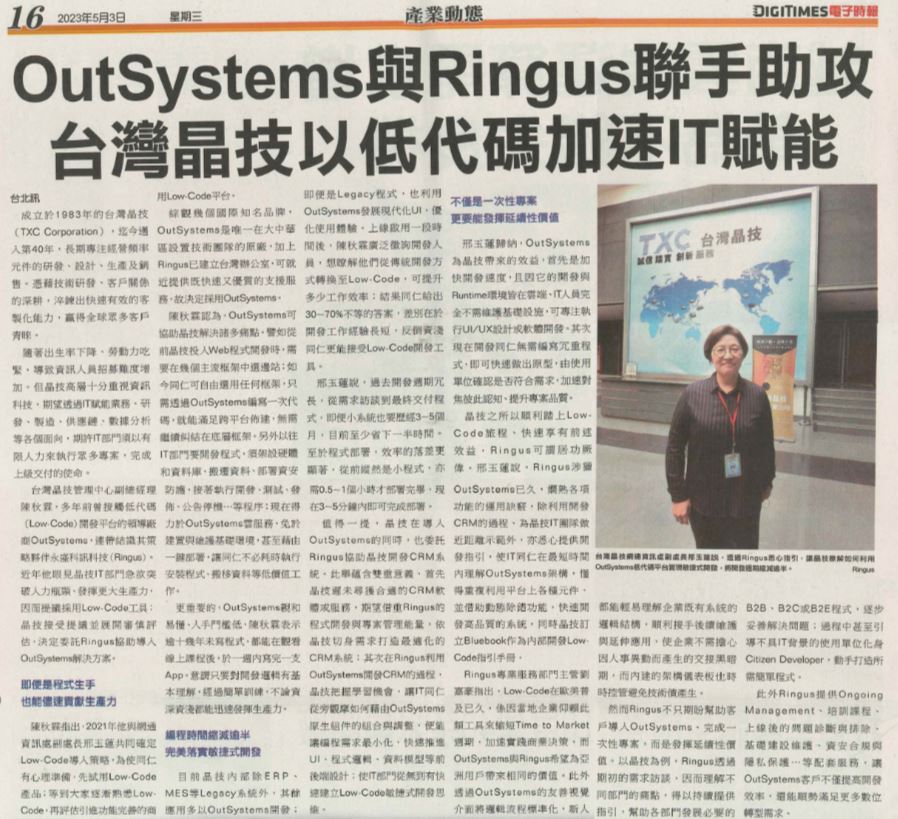
With the deployment of OutSystems to TXC Corporation in Taiwan, TXC transforms the application development lifecycle from traditional coding to low code development for further fulfill the agile development process. Productivity and time-to-market rate has improved given with the comprehensiveness of an all-in-one platform on OutSystems for visualized development, release and version control, application monitoring, etc. According to Mr. Kevin Chen, Deputy General Manager of TXC, OutSystems has significantly resolved many pain points and technical debts while long term operation costs could be reduced. Meanwhile, the engagement with Ringus successfully launched the first application on OutSystems for customer relationship management to demonstrate the power and capabilities of low code. With only a team of three members, the application which consists of client management, leads and opportunity handling, sales forecast management, etc. could be completed within four months from user requirement collection to production launch. 

For details, see OutSystems與Ringus聯手助攻,台灣晶技以低代碼加速IT賦能. 

More Updates

Further reading

Speed Without the Sprawl

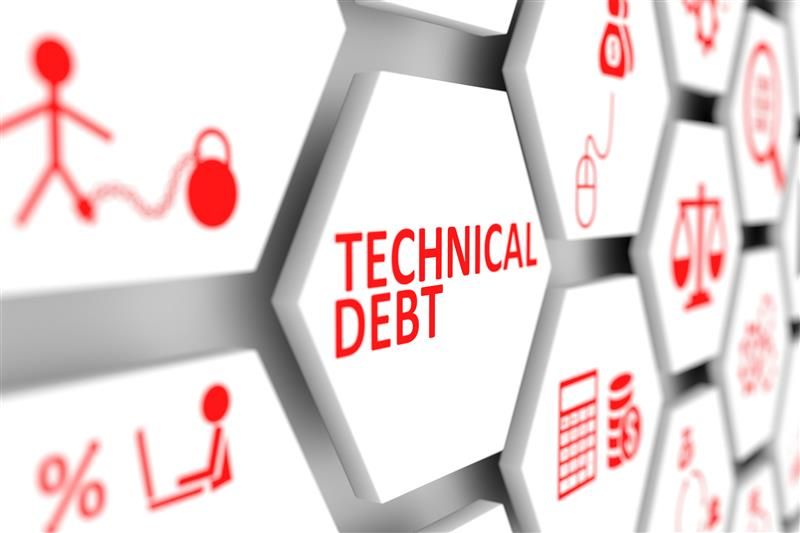
Leveraging OutSystems' rapid development strengths, our team achieves true Agile development, focusing intensely on user requirements. However, requirements are never fixed; they take time to refine within the project's cycle. If a developer simply builds projects based on the initial requirements, it leads to significant rework when those requirements are inevitably revised. This creates serious technical debt that can derail a project's schedule. To combat this, we strictly follow the OutSystems Canvas Design architecture to define each module's usage and content. We generalize logic into foundational modules, optimizing reusability and providing high adaptability when requirements change. This approach allows us to eliminate complicated dependencies—avoiding the deployment nightmares that plague monolithic systems. The Real-World Challenge: "The Spaghetti Monolith" We’ve all seen it. A project starts fast. The "Idea-to-App" time is record-breaking. But as sprints pass and requirements evolve, the "interest rate" on technical debt spikes. Suddenly, changing a simple UI element breaks a core business process because the logic was trapped inside the screen. Deployment becomes a "big bang" event where everything must go live at once because of circular dependencies. In our team, we don't just "code fast"; we architect for resilience. Our Solution: The 4 Layer Canvas Strategy We treat the 4 Layer Canvas not just as a suggestion, but as our structural imperative. Here is how we use it to handle volatile requirements:  Isolating Volatility (End-User Layer): We keep our User Interfaces (UI) and interaction logic in the End-User Layer. This layer is highly volatile—it changes constantly based on user feedback. By isolating it, we can redesign a "Customer Portal" without risking regressions in our core business rules.Stabilizing Business Logic (Core Layer): We abstract our entities and business rules into the Core Layer. This is the backbone of our factory. Whether the data is accessed by a Mobile App, a Web Portal, or a Timer, the validation rules remain consistent. This promotes the "Don't Repeat Yourself" (DRY) principle.Enabling Independent Deployments: By using Service Actions (Weak Dependencies) in our Core layer, we decouple our modules. This allows different squads to deploy changes independently without forcing a factory-wide refresh—a critical enabler for our CI/CD pipelines.The Governor: AI-Driven Architecture How do we ensure we stick to these rules when moving at Agile speeds? We don't just rely on manual code reviews; we use the AI Mentor System. This tool acts as our automated architect. It scans our entire factory to detect architectural violations that humans might miss, such as: Upward References: Preventing foundational libraries from depending on business logic.Side References: Ensuring our End-User apps don't tightly couple with one another.Circular Dependencies: Identifying the "deadly embrace" between modules that locks deployments.The AI Mentor System quantifies this debt, allowing us to pay it down proactively before it hinders our release velocity. Join a Team That Values Architecture In our Taiwan office, we believe that low-code doesn't mean "low-architecture." We are building resilient, composable enterprise ecosystems that can scale. If you are a developer who cares about structural integrity, clean code, and mastering the art of OutSystems architecture, we want to hear from you.